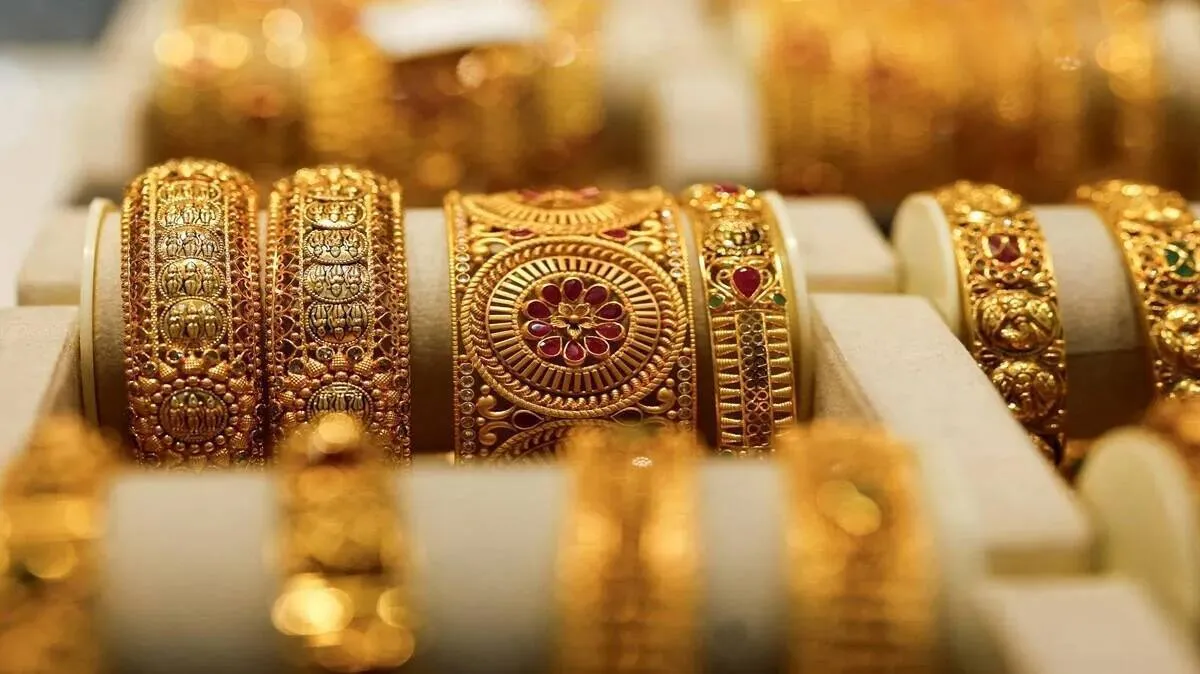
THIRUVANANTHAPURAM: The price of gold in Kerala have dropped sharply following weakness in international markets. The price of a sovereign (8 grams) of gold fell by Rs 3,160, reaching Rs 1,09,160, the lowest level of this month. The price per gram dropped by Rs 395 to Rs 13,645. Except for one day of increase, gold prices have been on a downward trend throughout the month.
Gold had reached its monthly high on June 1, when a sovereign cost Rs 1,14,560. Since then, prices have fallen significantly. The decline has been driven by several factors, including weakness in global gold markets, a stronger US dollar, rising oil prices, and higher interest rates.
At the time gold prices were fixed this morning, international gold was trading at around $4,342. Meanwhile, August gold futures on India's MCX opened Rs 2,517 lower (down 1.65%) at Rs 1,49,926 per 10 grams, compared to the previous close of Rs 1,52,443. Some losses were recovered during early trading, with futures trading at Rs 1,50,213, down 1.46%.
There is a possibility that gold prices may decline further in the coming days. Investors are closely watching the upcoming US Producer Price Index (PPI) data and the Federal Reserve's monetary policy announcements, both of which could influence gold prices. If the downward trend continues, it could create a favourable opportunity for long term investors looking to accumulate gold and families planning gold purchases for weddings and other major occasions.
Market volatility continues
Global financial markets remain highly volatile. Concerns over a possible escalation of tensions following Iran's recent attack on Israel, along with fears of higher US interest rates, triggered a sharp sell-off in stock markets earlier this week. However, markets rebounded after reports raised hopes of a possible diplomatic understanding between Iran and the United States. India's stock market recovered strongly: The BSE Sensex gained 395 points to close at 73,919. Nifty rose 119 points to finish at 23,242. Significant volatility continues across large-cap, mid-cap, and small-cap stocks.













 HOME
HOME LATEST
 NOTIFIED NEWS
 POLL
POLL KERALA
  EDITORIAL
  INDIA
INDIA  WORLD
WORLD  CINEMA
  SPORTS
  LIFESTYLE
  SPECIAL
  SCIENCE & TECHNOLOGY
 |
|