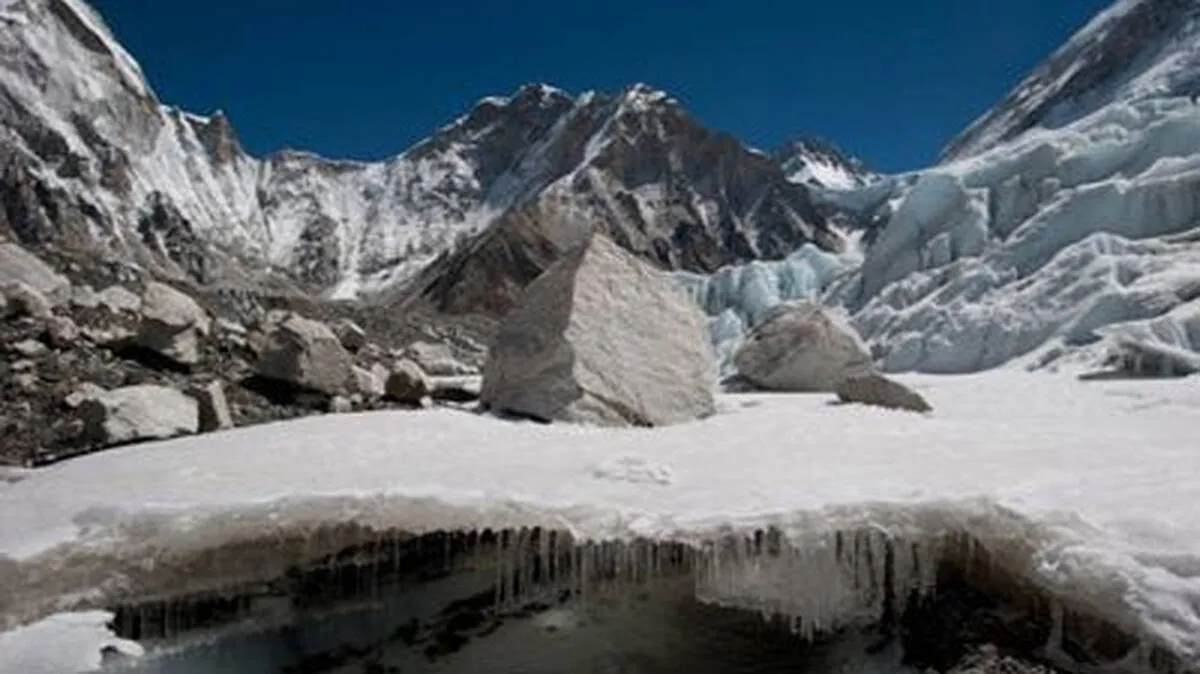
DEHRAADUN: As rising global temperatures directly impact the Himalayan region, the glaciers in Uttarakhand are also under threat. A recent study revealed that 23 major glaciers in Uttarakhand are melting rapidly. The study was conducted by scientists at the Wadia Institute of Himalayan Geology, and the research paper was published in the journal Discover Geoscience. After examining the historical records of the 23 glaciers, the researchers evaluated in detail the reasons behind the melting of each glacier.
The study states that rising temperatures caused by climate change and global warming are the main reasons for glacier melt. The shape and slope of each glacier, along with the amount of debris covering the ice, also affect the rate of melting. The study was published days after melting glaciers were linked to floods in Nepal that claimed the lives of more than 1,400 people. Uttarakhand has geographical features that are very similar to those of Nepal.
In recent years, huge chunks of ice breaking away from glaciers and flowing through valleys have caused major damage in populated areas. This has increased the focus of scientists, environmentalists and governments on glaciers that face risks in the Himalayan region. The Himalayan glaciers are a major source of water not only for India but also for neighbouring countries. They provide water needed for irrigation, drinking and hydropower generation.
An examination of historical records found that glaciers covered with debris melt by only a few metres every year. However, glaciers without debris melt at a faster rate. The study also pointed out that the rate of glacier melting has increased significantly since 2000. One of the major reasons is the change in precipitation patterns. Areas at altitudes of up to around 4,000 metres that previously received snowfall are now receiving rain.
Longer summers and a sharp decline in winter snowfall are also affecting the survival of glaciers. Another concern is that there is not enough time for the snowfall to form into a solid layer. Rapid glacier melting could increase the possibility of rising sea levels in the future. It could also increase the risk of natural disasters such as floods caused by glacial lake outbursts, avalanches and the flow of debris, including soil and rocks, from higher areas.
The water sources of rivers such as the Ganga, Bhagirathi, Sutlej, Ravi, Indus, Brahmaputra, Yamuna, Alaknanda and Mahakali are linked to the Himalayan region. India and neighbouring countries depend on Himalayan glaciers for agriculture, drinking water and hydropower.











 HOME
HOME LATEST
 NOTIFIED NEWS
 POLL
POLL KERALA
  EDITORIAL
  INDIA
INDIA  WORLD
WORLD  CINEMA
  SPORTS
  LIFESTYLE
  SPECIAL
  SCIENCE & TECHNOLOGY
 |
|