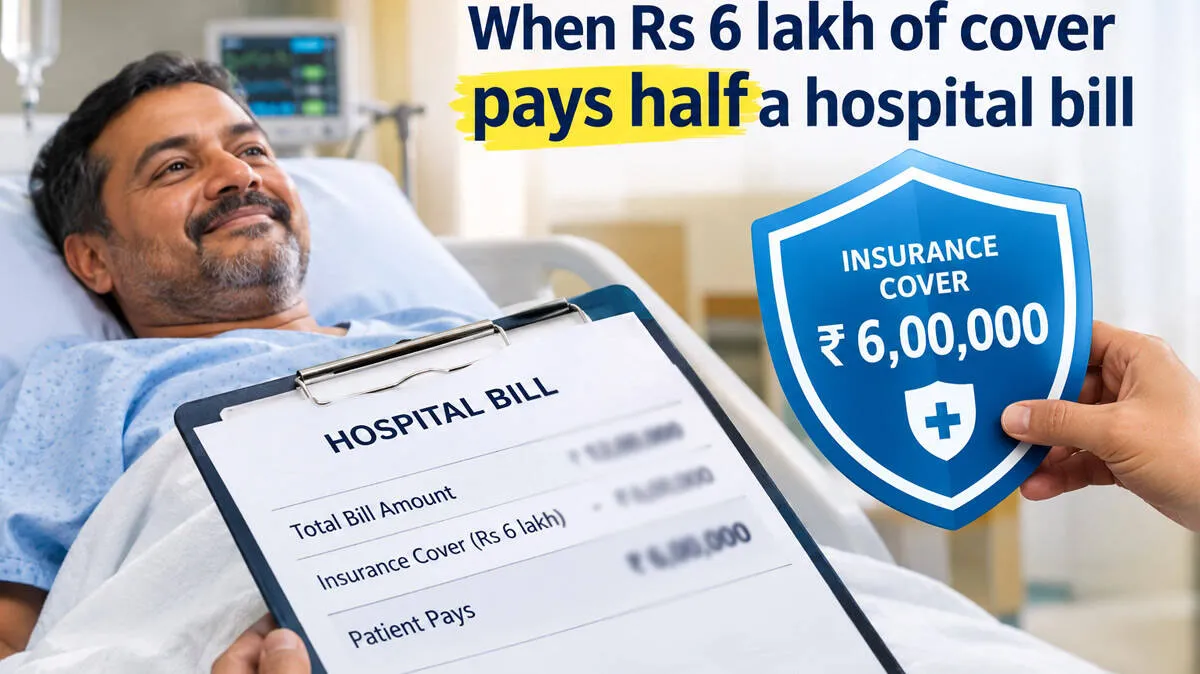
A recent hospital admission left a family with a question they had not expected to ask. Their health policy carried a sum insured of Rs 6 lakh. The bill was Rs 3.4 lakh, comfortably within that amount. Yet the insurer paid roughly half.
The reason was a limit on room rent and nursing charges: one per cent of the sum insured, or Rs 6,000 a day. The room cost more. Under the policy’s terms, crossing that limit also reduced payment for certain associated charges. The family had looked at the Rs 6 lakh figure when buying the policy. They understood the importance of the Rs 6,000 figure only when the claim was settled.
A room-rent limit is not, by itself, unlawful. Insurers may offer policies with such conditions, and the exact deduction depends on the policy wording and the claim. What troubles me is the distance between disclosing a condition and explaining what it will do. A buyer may readily accept that an insurer will not pay for a more expensive room. It is far less obvious that choosing that room could reduce payment for other parts of the treatment. That consequence ought to be understood before the premium is paid.
The Insurance Regulatory and Development Authority of India has now invited comments on how insurance is sold and how those who sell it are paid. Its consultation paper, issued on 23 September, does not propose to remove room-rent limits. Its concern is with the incentives and conduct of the distribution system through which most customers encounter insurance. That makes the family’s experience relevant to the discussion. What was explained at the time of sale determined how useful their cover proved at the time of need.
Insurance is often bought in the course of doing something else. A bank customer discussing savings is offered a policy with an investment element. A borrower arranging a home loan is presented with insurance alongside the loan papers. A family comparing health policies looks first at the premium and the sum insured. The seller knows considerably more about the conditions, the alternatives and the commission than the buyer usually does. That difference in knowledge places a real obligation on the person making the recommendation.
IRDAI’s figures explain why it is examining the incentive to sell. In a sample covering about 92 per cent of life insurance premium brought in through corporate agents, new business premium grew by 28 per cent between 2022-23 and 2024-25, while total distributor remuneration grew by 125 per cent. For general insurance business sourced through brokers, premium grew by 37 per cent over the same period, while commissions rose by 173 per cent. The two figures measure different channels and different forms of payment. Neither proves that a particular policy was mis-sold. Together, they show why the regulator is asking whether rewards for bringing in business have grown faster than the business itself.
The consultation proposes limits on commission based on the product, the channel and the work involved in selling it. It also proposes to reduce insurers’ overall expenses over five years, towards 12.5 per cent of premium for life insurers and 20 per cent for general insurers. Lower costs could improve value for policyholders. But a cheaper policy will be no comfort to a family that still learns its most consequential condition at the hospital.
The conduct proposals therefore matter as much as the cost proposals. IRDAI wants the individual who sold a policy to be identifiable and proposes recovery of commission when mis-selling is established. It also seeks to stop banks and other lenders from making insurance a compulsory addition to a loan, while permitting specified offers in which the borrower has a genuine choice. A borrower should be able to see the loan terms with and without the proposed insurance and, where insurance is chosen, obtain it from another provider.
For health insurance, the consultation should go one step further. A room-rent condition capable of materially reducing a claim should be explained through a worked example in the information given before purchase. The example need not predict every hospital bill. It need only show that a room costing more than the permitted daily amount may affect payment for specified associated charges. The seller should be expected to draw attention to that example. If the customer later says the effect was never explained, there should be a record against which that account can be tested. Merely adding another signature to a form will not achieve this.
Kerala has a particular interest in getting that right. The National Sample Survey conducted in 2025 found that 39.7 per cent of people in the state reported an ailment during a 15-day period, compared with 13.1 per cent nationally. It recorded 92 hospitalisations per 1,000 persons in Kerala over a year, against 29 across India. Kerala’s age profile and its greater use of medical care may help explain those numbers. They also mean that many households have occasion to discover what their health policy actually pays.
The issue extends beyond a single clause or a single kind of policy. In a recent case, IRDAI imposed a penalty of Rs 1 crore on Canara HSBC Life after a deferred annuity policy was sold through Canara Bank to an 88-year-old customer, although the product’s stated entry age ended at 80. That was a failure of suitability, distinct from the hospital claim. It shows how even a basic product condition can be lost in the process of making a sale.
There is, of course, an industry argument that deserves to be heard. Agents and bank branches bring insurance to people who might otherwise remain uncovered. Reduce their income too abruptly and that work may suffer. IRDAI has recognised the problem by proposing additional commission for business from smaller towns and rural areas. The test, however, is whether wider reach produces useful protection. Issuing more policies will mean little if the conditions that matter most are still left for customers to discover when they make a claim.
Comments on the consultation close on 25 October. The proposed reduction in expenses can take place over time. Clear responsibility for a sale need not wait five years. Name the person who sold the policy. Preserve the borrower’s choice. Show a health insurance buyer, before purchase, how a room-rent limit can affect a claim. For the family facing a Rs 3.4 lakh hospital bill, those changes would matter more than any improvement in an insurer’s expense ratio. They would allow the buyer to know, while there is still time to choose, what the Rs 6 lakh cover is worth.













 HOME
HOME LATEST
 NOTIFIED NEWS
 POLL
POLL KERALA
  EDITORIAL
  INDIA
INDIA  WORLD
WORLD  BUSINESS
  CINEMA
  SPORTS
  LIFESTYLE
  SPECIAL
  SCIENCE & TECHNOLOGY
 |
|