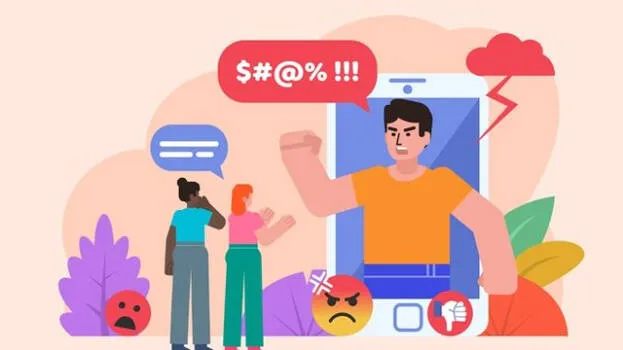
Online media often turns complaints filed by one person against another into news content. Even if the complaints are truthful, they are one-sided. It is common knowledge that half of the complaints filed in police stations and courts in our country are false and fabricated due to personal enmity. Complaints are often filed with the most serious allegations possible in order to add non-bailable sections. Then, it is easy to demonise, ridicule, and demean a person based on that complaint alone. However, online media pays no attention to the important fact that the audience can assess the truth of the complaint only when the opposing party explains that there is another side to it.
The creation and presentation of such content by YouTubers, vloggers, online media, influencers, etc. can be seen as soon as one unlocks their mobile phone. Making obscene remarks and defaming innocent people and even mocking the differently-abled people for their shortcomings are happening without any control. Today, social media is a place where anyone can say anything about anyone. Videos with misleading headlines and accompanied by obscenity have become a regular occurrence as YouTube and other social medias have started paying more money with increased number of views. As this trend is threatening the very existence of a healthy society, public interest groups are constantly demanding control over it.
The Supreme Court's request to the Centre to set up an autonomous mechanism to oversee obscene, offensive, and illegal content on online platforms is a welcome development. A bench of Chief Justice Suryakant and Justice Joymalya Bagchi expressed dissatisfaction with the current self-regulation mechanism. An independent and impartial mechanism is needed to check the legality of online media content. The court also pointed out that although freedom of expression is important, the right to life is above it, which is completely correct in the current situation. The court directed the Centre to publish a draft guideline on regulation and to constitute a committee of experts to study the issue while considering a case related to the obscene remarks made by a YouTuber on the 'India's Got Latent Show'.
Such a committee should be composed of members who are not beholden to the government, the private sector, individuals, or politicians. The court should also direct how the government should find them. Otherwise, there is a possibility that the members appointed by the government will end up only cutting the content of news that incriminates the government. Since the court has said that suggestions should be submitted after public consultations, the central government should take immediate steps to move in that direction. The current recklessness of online media with content that violates the limits must be curbed.












 HOME
HOME LATEST
 NOTIFIED NEWS
 POLL
POLL KERALA
  EDITORIAL
  INDIA
INDIA  WORLD
WORLD  CINEMA
  SPORTS
  LIFESTYLE
  SPECIAL
  SCIENCE & TECHNOLOGY
 |
|